These are the questions every first-time Namibia self-driver asks — answered straight, from real road data, not blog optimism. Each one ends the same way: the only honest answer for your route is to check it.
TripPace gives every driving day one of three plain verdicts:
A comfortable driving day with time for stops and sightseeing.
Manageable, but needs an early start and a fuel plan.
Most travellers split this drive. Add an overnight to make it work.
How many days do you need for a Namibia self-drive — and is your itinerary too much?
Plan at least 10 days for a first Namibia self-drive, ideally 14. Under a week and the distances force days so long you spend the trip driving instead of seeing it. But the real test isn’t the day count — it’s whether each individual driving day is realistic, and that depends on your exact stops.
Seven days covers the essentials — the dunes at Sossusvlei, the coast at Swakopmund, the wildlife of Etosha — if you’re adding Namibia to a longer Africa trip. Ten to fourteen days is the comfortable length for a standalone loop.
The trap is cramming a fourth region — the south, or the Caprivi — into two weeks. It looks fine on a map. On gravel, one over-long leg can quietly wreck an otherwise good trip.
A map shows you distance. It doesn’t show you whether the day works. TripPace gives every driving day a plain verdict — doable, tough, or impractical — so you find the broken day before you’re standing on it.
How far apart is everything in Namibia, and how long do the drives really take?
Namibia’s distances are bigger than they look and slower than Google Maps assumes. Gravel roads run at roughly half the speed of tar, so the same 400 km can be an easy morning or a full, draining day depending on the surface — and you should refuel daily, because fuel stops can be hundreds of kilometres apart.
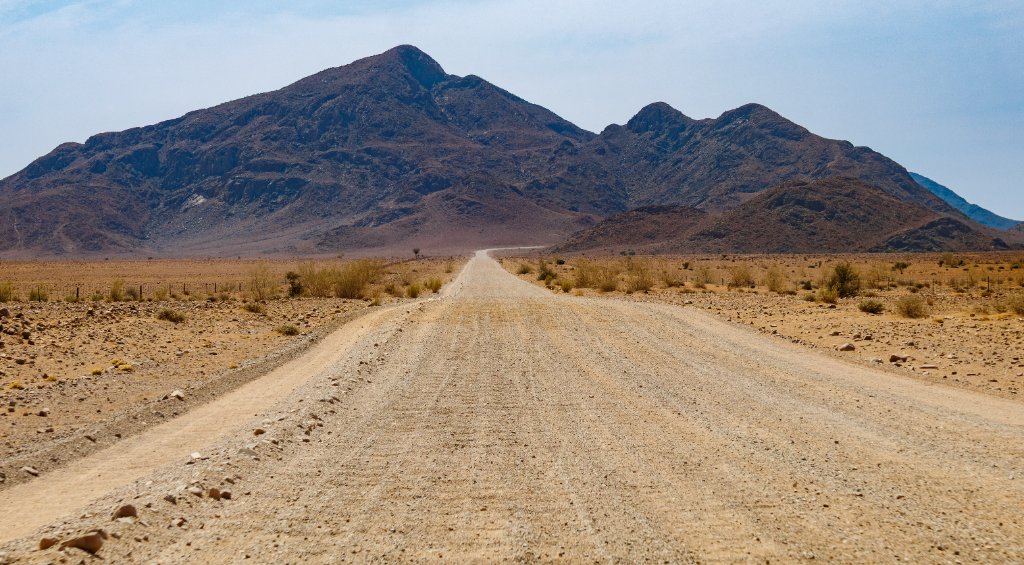
Most of Namibia’s best places sit on gravel, and gravel doesn’t drive like a highway. A distance Google Maps calls a few hours can be most of a day once you account for the surface, the dust, and the stops.
Fuel gaps of 300–400 km exist on common routes. Running dry in Kaokoland or the Caprivi isn’t an adventure — it’s a preventable problem. Treat every fuel stop as your last.
TripPace calculates each leg from real Namibia road data, surface by surface — not a Google Maps estimate. You see the honest drive time before you commit to the day.
What’s the best Namibia self-drive route?
The classic loop is Windhoek → Sossusvlei → Swakopmund → Damaraland → Etosha → back to Windhoek — roughly 2,850 km over 10 to 14 days. It’s the standard for good reason, but the right order and pacing depend on your time, your interests, and which days you can actually absorb.
The loop works because it threads Namibia’s four signature landscapes without doubling back. Direction matters: stops are best visited in order along your heading, with backtracking saved only for genuine dead-end detours like Epupa or the Caprivi.
The standard version isn’t always the right one for you. Where you start, which way you run it, and which stop earns the extra night all change the trip — and whether it holds together on the road.
TripPace orders a route by what breaks it first — fewest impractical days, then fewest tough days, then the shortest worst day. One impractical day is worse than two tough ones, and the order reflects that.
Do you need a 4×4 for Namibia, or is 2WD enough?
2WD is enough for the paved roads and main gravel routes — Windhoek–Sossusvlei–Swakopmund, and Etosha in the dry season. You need a 4×4 for the final sandy stretch into Deadvlei, Damaraland, the Skeleton Coast, the smaller D-roads, and anywhere in the rainy season (roughly November to April).
Plenty of the classic loop is comfortable in a 2WD. The catch is that the places needing a 4×4 are often the ones people most want to reach — so the vehicle you book quietly decides which stops are even on the table.
Rental agreements add another layer: many prohibit certain gravel roads or require a 4×4 for specific routes. Your vehicle type isn’t just comfort — it’s a routing input.
TripPace flags access — 2WD or 4×4 — for every destination and road. Change the vehicle and the feasible route changes with it. No generic “just get a 4×4.”
Can you add Botswana, Victoria Falls or Cape Town to a Namibia trip?
You can — but it’s where most itineraries break. Bolting the Caprivi/Botswana side or Victoria Falls onto a two-week Namibia loop usually means driving days long enough to spoil both halves. Whether it works is a question of days, not desire.
Experienced hands will tell you straight: on a standard two-week trip, the Okavango, Chobe or Vic Falls add-on is often too much driving. It fits when you’ve got more days, or when you fly one leg instead of driving it.
TripPace won’t pretend to know roads it doesn’t. An out-of-country excursion is marked plainly — outside Namibia, not assessed — with no invented drive time. Honesty is the feature.
TripPace assesses your Namibia legs honestly and lets you add a cross-border excursion without bluffing a number — so you’ll see whether the add-on leaves realistic driving days inside Namibia.

We use a cookie for anonymous analytics (Google Analytics) to see how the site is used and make it better. It only loads if you accept. You can decline and the site works exactly the same. See our privacy policy.